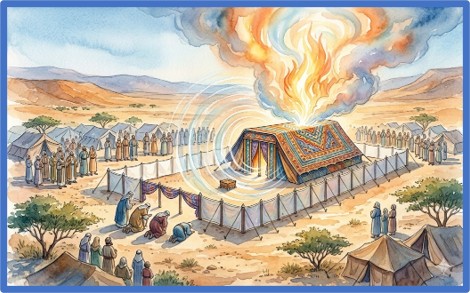
Wayyiqra
On Palm Sunday, March 29, 2026, Crossroads Connection began a two-week focus on the book of Leviticus with a message titled "Wayyiqra" — the Hebrew word meaning "the Lord summoned" or "the Lord called." Preaching from Leviticus 1:1, David traced Israel's time alone with God in the wilderness to his own season of solitude after divorce, and to the isolation borne by Paul and by Jesus in Gethsemane and on the cross, showing how God uses aloneness to form and refine His people. The service moved from the Palm Sunday procession into a solemn call to confession and assurance of pardon, culminating at the Lord's Table, where David invited the congregation — especially those who feel forgotten or shut out — to come as they are, since Jesus does the cleansing rather than requiring it first.
https://youtu.be/THSmrab0R6k?si=j5F9HnWRjdn-dMtX
Introduction
God is Good, all the time, and all the time, God is Good
Welcome, My name is David McBride. This is my home church.
I was called here in 2015, after my mom passed away.
I’d been wandering away from the church for about 25 years.
Soon after arriving here, I was called to the church mission team, where I was then called to the Crossroads ministry.
Responding to those calls, has deeply changed my life.
I am truly blessed to lead us all in worship tonight.
Announcements
First, there are a few announcements
- Crossroads is a partnership of churches – Next dates
- We have free Bibles and Offer Scholarships
- Jamming, restrooms
Today on the church Calendar is Palm Sunday. It get’s that name from the Palm Branches that we’re laid along the road as Jesus made his Triumphal Entry into Jerusalem.
His entry was just a few days before the Jewish Celebration of the Passover. A big day commemorating the night God saved the Israelites from destruction while they were slaves in Egypt.
There was great hope that Jesus was the long awaited Messiah who would again save the Jews from Roman oppression.
People were exited and they sang Hosanna, God saves, as Jesus rode into the city.
But things quickly turned.
Jesus was betrayed, rejected, condemned, and abandoned to die.
This coming week is known as Holy week.
Thursday, we celebrate Maunday Thursday. It commemorates the night Jesus washed his disciples feet and instituted the Last Supper.
Friday is Good Friday. The day we ponder the Crucifixion of Jesus.
And Next Sunday is Easter. When we celebrate His resurrection from the dead.
A lot happens in just a short time.
Since this congregation isn’t able to have the typical holy week services. I’ve attempted to condense it all into this service.
First, I want us to experience the joy of Palm Sunday. I’ve asked____ to pass out palm fronds.
They are going to bring these and I want you all to take them and pass them saying Hosanna, God saves.
Prayers if the People
I’ve been reading a really good book on prayer by Charles Spurgeon. In it, he tells a story about the love God has for us and the joy it gives God when we come to Him in prayer trusting that He
The Message
Some of you might remember how I proudly announced back in January that I had begun a plan to read through the Bible in a year.
Well, I made it through Genesis and Exodus. Then stopped dead in my tracks when I got to Leviticus.
The book of Leviticus gets that name because it contains instructions for the Levite Priests, one of the 12 Tribes of Israel.
I found those instructions distant and confusing and lost all interest in my reading plan
So, I abandoned it.
But God called to me, saying just sit there in Leviticus as long as you needed. Don’t worry about the Bible in a year. Slow down and focus on this one book.
So, I asked God to help make sense of all the strange and complicated things.
I mean, out of nowhere, the Bible seems to turn into a detailed lesson in cattle butchery and witchcraft.
How could any of that make sense, I asked?
I turned to my study Bibles for answers. And I have to be honest that at first they weren’t much help
Even some of my favorite Bible commentators, like Burton Coffman, didn't have what I was looking for..
- I searched the internet.
I bought more commentaries.
In one[1], the introduction to Leviticus says:
"Leviticus, that proverbial book in which the best-laid plans to read the whole Bible cover to cover come to a grinding halt. The resolute reader immediately finds themself immersed in arcane details of animal sacrifice. What in the world could this ancient manual of sacrifice have to do with faith or spiritual life today?"
That made me laugh, since I've said the same thing many times.
But here I am, spending two Sundays with Leviticus as the focus of our worship.
And honestly, two Sundays isn't nearly enough.
From all I’ve found, we could spend the whole year uncovering its secrets.
It truly is a marvelous book, when you have the right help.
So before we go any further, let's pray:
Lord of all wisdom, slow us down. Get us alone with You. Help us understand the details. Bring clarity into our confusion. Amen.
The truth is, Easter only makes sense because of the themes introduced in Leviticus — the sacrificial lamb, atonement, the shedding of blood. These are central teachings of our faith.
Yet… these topics can be a challenge to understand. It took years of Bible study, and even now I sometimes struggle with them.
And while, they are the centerpiece of Christianity, Leviticus has more to offer, more to shape us, more to form us into the holy people God desires.
And, I’m excited to share some ways it’s been forming me.
First, let's briefly touch on its authenticity.
Modern scholars debate whether Leviticus was written by Moses or penned much later.
After my study, I'm resting on strong evidence from early theologians and even modern scholars that Moses is its author[2].
Henry Morris, notes that Leviticus is written mostly as direct quotations of God speaking to Moses.
In fact, the Hebrew title for the book is Wayyiqra,
- meaning The Lord Summoned, or The Lord Called
which echoes its first verse:
"The Lord summoned Moses and spoke to him from the tent of meeting."
But perhaps more important than who wrote it, is to whom it was written…. and for what purpose.
In John Maxwell’s Leadership Study Bible, John notes that in Leviticus,
"God establishes a pattern of life for both His leaders and His people; that the first sixteen chapters teach us how to approach God, while the last eleven teach us how to relate to Him and to each other.
………
The goal was to form Israel from a wandering, meandering crowd into a meaningful community."
And that's exactly where this message is headed, to catch us in our wandering and form us into a community of meaning.
One of the meaningful communities God has called me, is to the church choir.
Back in January, we began practicing songs for Easter, a couple of which you just heard.
When we first practiced them, we spent an hour meditating on their words. Singing them again and again.
Alone. Alone. Alone.
Rejected, abandoned, Alone
Those thoughts sat heavy in my heart.
I know what it feels like to be alone…. and rejected.
And I suspect many of you do as well.
So when I read that Leviticus finds the Israelites alone with God in the middle of the desert[3], I felt the Holy Spirit’s work in this.
Leviticus is the middle book of the Torah, which is the first five books of the Bible, also known as The Law. It's sandwiched between Genesis and Exodus, and Numbers and Deuteronomy.
In Genesis, we read about the first families of the world and all their brokenness and drama. In Exodus, we read about the nation built from one family line and their journey to freedom.
Numbers and Deuteronomy continue that journey.
In those books, Israel is on the move.
But Leviticus, it happens in a single place.
At the foot of an impossible mountain of rules and regulations.
And there, in their chaos,
we find God refining and forming His people.
Transforming them so they become holy enough to reach God.
It got me thinking about my own life.
About the times God has grown me the most.
First, God had to slow me down.
Stop me.
Get me alone.
And really go to work on me.
And I’m still in that tough formative period.
After I became single in 2020, I felt a little abandoned and lost. As I was reading a book on life after divorce, it talked about how profoundly God can use us during some of the hardest times of our life. Especially when we are alone.
In fact, John Calvin, Who is widely regarded as the founder of the Presbyterian denomination, wrote The Institutes of The Christian Religion
- that's this thick book
while he was single… alone.
That might be why I’ve recently taken the words of Paul in 1 Corinthians 7 with real weight — verses 32 to 35 —speak of the unmarried man being free from distraction, devoted wholly to the Lord.
You know, this sermon probably wouldn't have come together without that undistracted and undivided devotion.
Paul himself experienced some extreme times of isolation. He wrote three of my favorite New Testament chapters while confined in prison: Ephesians, Philippians, and Colossians. Those beautiful books contain some of the most meaningful and inspiring words of our faith.
Paul was able to write them because he was a man who had met Jesus and was transformed. Bondage couldn’t lock away his faith, his joy was unshakable.
And that joy? He learned it from the One who modeled it first.
Jesus himself experienced many times of aloneness.
We have the story of Jesus alone in the wilderness being tempted by Satan but able to remain faithful because of His devotion to God.
After the triumphal entry into Jerusalem, Jesus again finds Himself alone.
In the garden of Gethsemane, his closest friends fall asleep instead of staying with Him in prayer. But Jesus’s trust in God sustains Him.
After Jesus’s arrest, His friends abandon him. And He dies alone on the Cross that God had summoned Him too.
We red Psalm 22 as the call to worship, which echo his words on the cross. But as we’ll see next week when we read the final words of that Pslam. Jesus already knew it wasn’t the end. There was something better ahead, through the suffering.
And that brings us back to our broad overview of Leviticus.
That time alone in the wilderness with God, it had a purpose.
It was to heal the people of their sin and make them whole.
The same is true for us. Our trials have a purpose.
One of my favorite Bible verses, James 1:2-4 beautifully says:
Consider it pure joy, my brothers and sisters, whenever you face trials of many kinds, because you know that the testing of your faith produces perseverance. Let perseverance finish its work so that you may be mature and complete, not lacking anything.
There is something about that verse that sustains me and I can’t recall the number of times it has helped me find joy in my hardships.
Another one like it is Romans 5:3 and 4 which says:
We can rejoice, too, when we run into problems and trials, for we know that they help us develop endurance. And endurance develops strength of character, and character strengthens our confident hope of salvation.
What kind of wisdom is that? To rejoice when we run into problems? To consider it all joy?
It only makes sense when we see it in the light of our formation. As a development of our endurance and character. And ultimately our salvation.
And 2 Corinthians 1 verse 3 and 4 explains the kind of character it’s developing. It says
Blessed be the God and Father of our Lord Jesus Christ, the Father of mercies and God of all comfort, who comforts us in all our affliction, so that we may be able to comfort those who are in any affliction, with the comfort with which we ourselves are comforted by God.
For the Christian, our suffering and God’s comfort in it is the reason we develop a character of empathy.
Christianity is a faith that welds meaning into suffering.
Suffering has a divine purpose.
It’s the reason I do this ministry each week. My life has not been easy, but because of my difficult experiences, I am summoned to share the pure joy I’ve found in Jesus.
Our faith is not a solitary faith.
It’s an intimate relationship with the creator of the universe.
This God draws us into joyous relationship and then equips us so that we are empowered to endure hardships and be a blessing in the lives of others.
With that, I want to turn to the table set before us. This table looks back to the first Holy Week. Where Jesus sat with his closest friends to share a meal.
You might have come tonight for various reasons.
- Maybe you're a family member of an inmate and feel abandoned.
- Maybe you're the husband who sits back in their cell, surrounded by hustle and bustle, yet feeling alone and rejected.
Maybe you came tonight because you heard there would be a good meal.
But I know there’s a deeper purpose. You’re not here tonight just to get physically fed. You are being spiritually nourished.
God has summoned you.
So as we get ready to share this Sacrament together, I want to share another gleaning[4] from Leviticus.
All the rules showed the people how separated they were from God.
Common folk weren't allowed in God’s direct presence.
Even the high priest had to follow a list of difficult rules and rituals in order to get near God.
In fact, while I was studying, I found diagrams of the various rules that had to be carried out. A few of them are preinted in the bulletin .
Those charts got me thinking about the table set here.
It is the table of the Lord, set by Jesus himself, God in the flesh.
It's a total undoing of the closed-off-ness of God.
Instead, it reveals the closeness of God. Jesus welcomed the children, the poor, the sick, the addicts, all those who society shunned the most.
And, If you don't know Him yet as Lord and Savior — tonight is your invitation. He has summoned you here. And this table is His way of saying: come.
Jesus doesn’t give you a complex maze of rituals to follow; you don’t need to clean yourself up before coming.
Jesus does the cleansing. You just need to come, ready and willing, wanting to be healed and made whole.
Jesus prepared this table so we can be together as a community, He doesn't want you sitting out there alone, feeling abandoned or rejected. He wants you to leave your shame behind and come joyfully to this table.
Benediction:
"Some of you know what it feels like to be summoned. You get that paper and your stomach drops.
But when Jesus summons you — like God summoned Moses, like He's summoning you tonight — it's not to condemn you.
It's to form you.
To draw you close.
To speak to you.
To change you.
Then to direct you out to find others who feel alone.
To brighten their day.
To see them.
To make them feel known and to help them to know the One who completes and makes us whole.
So as you Go, know you are not alone. God goes before you. God goes with you. God is for us, not against us. Wanting us not to wander through life without meaning, but instead to form meaningful communities.
Page of
[1] Mary Healy, introduction to Leviticus, in Word on Fire Bible, Vol. 3: The Pentateuch, ed. Robert Barron (Park Ridge, IL: Word on Fire Academic, 2023)
[2] Modern: Henry Morris, Burton Coffman.
1st Century Proponents: Philo of Alexandria and Flavius Josephus
[3] Richard Elliott Friedman, Commentary on the Torah (New York: HarperOne, Kindle edition), 1624.
[4] Vijay Thangiah, “GLEANINGS – Leviticus,” YouVersion Bible App, accessed via https://www.bible.com/reading-plans/39345-gleanings-leviticus.
Other resources used during the research of this message:
- Richard Elliott Friedman, Commentary on the Torah (New York: HarperOne, Kindle edition), 1624.
- Gregorio Guitián, Theology of Work: New Perspectives, Routledge New Critical Thinking in Religion, Theology and Biblical Studies (London: Routledge, Kindle edition), 151.
- NRSV Cultural Backgrounds Study Bible (Grand Rapids, MI: Zondervan, 2019).
- NKJV Maxwell Leadership Bible (Nashville: Maxwell Motivation, Inc., 2002, 2007, 2018).
- Mary Healy, introduction to Leviticus, in Word on Fire Bible, Vol. 3: The Pentateuch, ed. Robert Barron (Park Ridge, IL: Word on Fire Academic, 2023).
- Robert Barron, ed., Word on Fire Bible, Vol. 3: The Pentateuch (Park Ridge, IL: Word on Fire Academic, 2023).
- Stephen Arterburn and David Stoop, eds., Life Recovery Bible, New Living Translation, Large Print (Carol Stream, IL: Tyndale House Publishers, 2017).
- Henry Morris, The KJV Henry Morris Study Bible (Green Forest, AR: Master Books, 2022).
- Vijay Thangiah, “GLEANINGS – Leviticus,” YouVersion Bible App, accessed via https://www.bible.com/reading-plans/39345-gleanings-leviticus.
- William M. Ramsay, The Westminster Guide to the Books of the Bible (Louisville, KY: Westminster John Knox Press, 1994).
- The New Interpreter’s Bible, vol. 1 (Nashville, TN: Abingdon Press, 1994).
About Crossroads Connection
Crossroads Connection Omaha is a reentry ministry serving men and women coming out of incarceration. Each Sunday evening, we gather for worship, the Word, and a shared meal — because the table is never just about food.
If you'd like to support this ministry or learn more, contact us here.
© 2026 David McBride / Crossroads Connection Omaha
Scripture quotations from the NLT and NIV. Song lyrics referenced under fair use for ministry reflection purposes.